
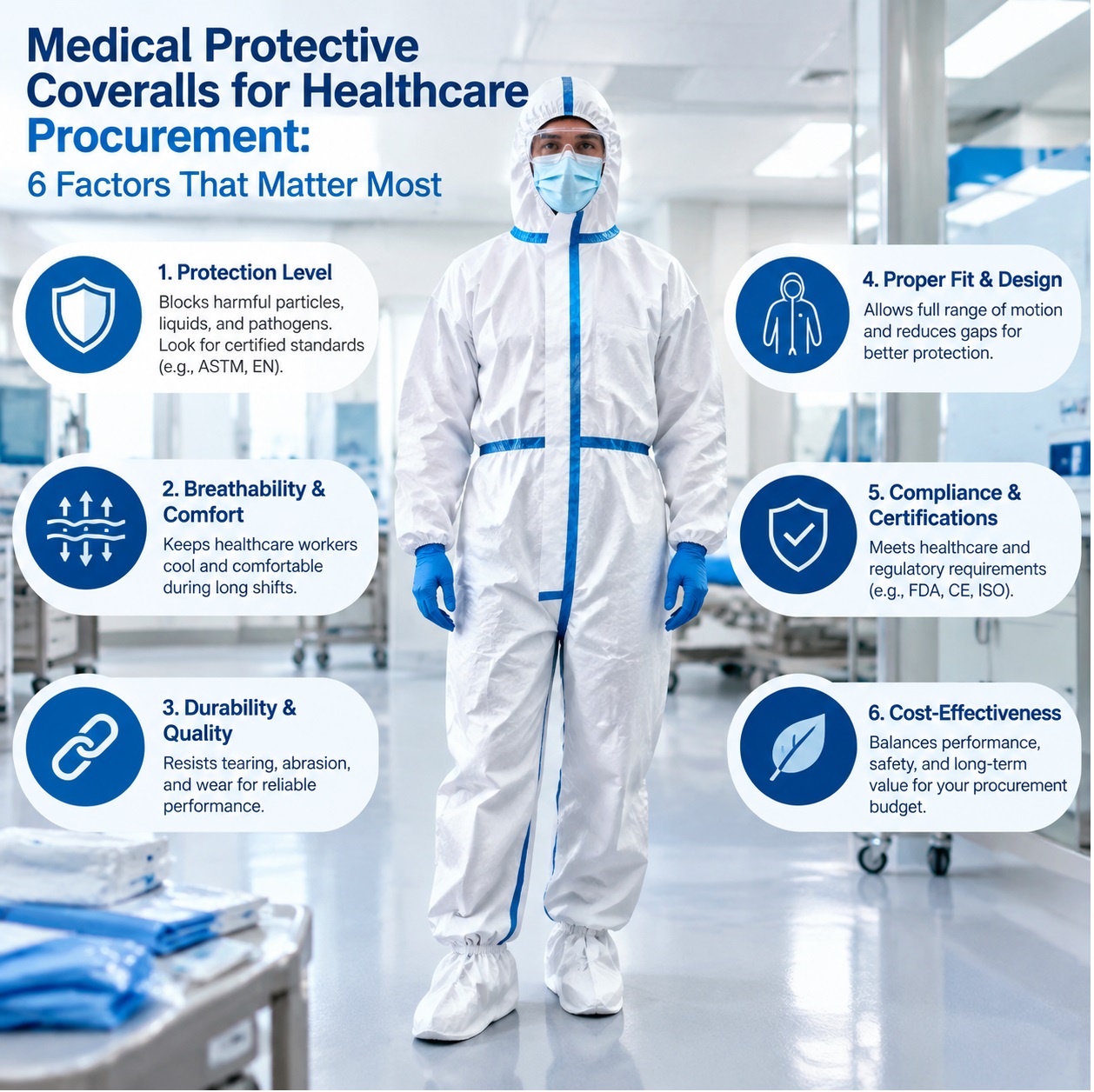
 Nobody gets fired for buying the cheapest coverall on the quote sheet. They just get the phone call three weeks later, when a nurse pulls a torn sleeve out of a linen bin and infection control wants to know who signed the purchase order.
That is the strange thing about this category. Every coverall looks identical in a photo. White or blue, zip up the front, elastic here and there. Put six of them side by side on a table and even experienced buyers squint. The differences live in places you cannot see: the seam tape, the film weight, the breathability numbers, the test report that may or may not have been issued for the exact fabric in the box. By the time those differences show up, the product is already on someone’s body.
So here is what actually separates a coverall you can defend from one you will eventually have to explain.
- Match the barrier to the task, not to your anxiety.
The fastest way to waste money in a procurement cycle is to standardize on the highest protection level for every department. It feels safe. It is also how you end up with a warehouse full of Level 4 garments that nobody wants to wear for an eight-hour shift, plus a budget that collapsed in Q2.
Start by mapping where medical protective coveralls are actually used. General ward work, patient transport, low-fluid housekeeping: a lighter SMS or spunbond garment may be entirely appropriate. Emergency departments, ICU, surgical support, any task with meaningful splash or spray risk: now you are in film-laminated or coated territory, and the standard you are buying against needs to be written into the specification, not assumed.
Know which framework your buyers are citing. In the United States, AAMI PB70 levels 1 through 4 dominate gown and coverall discussions. In Europe, EN 14126 for infectious agents sits alongside the Type 3 through Type 6 classifications for liquid and particle protection. These are not interchangeable, and a supplier who cannot tell you precisely which one their garment was tested against is a supplier who has not read their own paperwork.
- Seams and closures are where protection quietly dies.
A coverall is a barrier with holes deliberately cut into it. The question is what the manufacturer did about the holes.
Serged seams are stitched and fast. They are fine for dry particle protection and low-risk environments. Taped seams, where a strip of film is heat-sealed over the stitch line, are what you want anywhere liquid is involved. If your specification says “taped seams” and the sample arrives with stitching you can see, that is not a minor deviation. That is a different product.
Then look at the front. A single zipper is a channel. A zipper with a storm flap is a channel with a door. A zipper with a flap plus a self-adhesive or taped closure at the top is what a serious garment looks like. Check the cuffs too. Elastic wrists and ankles are the norm, but the quality of that elastic determines whether the cuff is still snug at hour six or has relaxed into an open sleeve.
If you are evaluating samples, do not just look at them. Fill one with water and hold it over a sink. It is crude and it is remarkably revealing.
- Breathability is a compliance problem wearing a comfort costume.
Here is the pattern that repeats in every facility I have worked with. Procurement buys a heavier, cheaper, less breathable coverall because the price per unit looks better. Staff wear it for two shifts, overheat, and start doing things like unzipping to the sternum during breaks, or leaving the hood down, or reusing a garment that was designed for single use. Compliance falls off a cliff, and the savings evaporate.
Heat stress is a documented occupational hazard in coveralls, particularly in non-climate-controlled areas or during long procedures. If a garment traps moisture and heat, your infection control policy now depends on human beings doing the uncomfortable thing for eight hours straight. Most will not.
Ask suppliers for breathability data, not marketing adjectives. Look for moisture vapor transmission rate figures if they exist. If a supplier cannot produce a number, assume the number is bad.
- Sizing that accounts for real bodies and real shifts.
Letter sizes on coveralls are close to meaningless across manufacturers. A “Large” from one factory can fit like a Medium from another. For a workforce that is genuinely varied in height and build, that mismatch produces two failure modes: garments so tight that seams strain when the wearer reaches overhead, and garments so oversized that fabric bunches and catches on equipment.
Ask for a full measurement chart in centimeters or inches, not just S through XXL. Check sleeve length and torso length separately, because tall and short staff both get punished by one-size logic. And if your facility has a meaningful number of staff who need extended sizes, confirm those are actually in stock rather than a special order with a twelve-week lead time. Nothing undermines a standardization program faster than the people who cannot get a garment that fits.
- Paperwork that survives an audit.
This is the unglamorous factor, and it is the one that decides whether your purchase order becomes a problem later.
For each product, you should be able to obtain: the relevant test reports from an accredited laboratory, the specific standard and classification level, a declaration of conformity, and lot or batch traceability so that a problem in the field can be traced back to a production run. Sterility claims, if applicable, need their own validation and expiry documentation.
Two traps to watch. First, a test report for a fabric is not automatically a test report for the finished garment. Seams and closures change performance, and a garment-level test is what matters. Second, certificates that cannot be tied to a specific production batch are decoration. Ask how you would trace a defective box back to its manufacturing date. The answer tells you a lot about the supplier.
- Supply behavior, which is the factor nobody puts on the scorecard.
Price per unit is a snapshot. Supply reliability is the whole film.
Ask about lead times under normal conditions and under strain. Ask about minimum order quantities and whether they flex. Ask what happens when a hospital system three states over suddenly doubles their order. Ask how the product is packed, because a case of 25 loose garments and a case of 25 individually bagged garments are different products for a facility that needs to hand them out at a station. Ask about shelf life and storage conditions, especially for film-laminated products that degrade with heat and UV.
And then do the unglamorous math: cost per use, not cost per box. A cheaper coverall that staff refuse to wear, or that fails at the seam, costs far more than the premium option once you add the replacement order, the incident review, and the credibility hit with your clinical team.
A practical way to run the next tender
Build a short specification before you look at a single quote. Barrier level by department, seam type, closure type, minimum breathability figure, sizing range required, documentation package required, and packaging format. Then score suppliers against that, with price as one column rather than the whole spreadsheet.
Order samples in three sizes and put them on real people for a real shift. Ask the staff who wore them what failed. Their answers will be more useful than any datasheet.
Coveralls are not a commodity, even though the market treats them like one. They are a piece of personal protective equipment standing between a healthcare worker and something they would rather not be exposed to. Procurement gets to decide whether that barrier holds. It is worth the extra week of diligence.
If you are building a specification and want garment-level test data, sizing charts, and batch traceability documentation to review before you commit, ask for it. A supplier who hesitates is telling you something. A supplier who sends it all without being asked is telling you something better.